All posts by markdangerchen

Mark Chen is an independent researcher of gaming culture and spare-time game designer. He is the author of Leet Noobs: The Life and Death of an Expert Player Group in World of Warcraft. Currently, he is looking into experimental and artistic games to promote exploration of moral dilemmas and human nature, researching DIY subcultures of Board Game Geek users, and generally investigating esoteric gaming practices. Mark also holds appointments at Pepperdine University, University of Washington, and University of Ontario Institute of Technology, teaching a variety of online and offline courses on game studies, game design, and games for learning. He earned a PhD in Learning Sciences/Educational Technology from the University of Washington and a BA in Studio Art from Reed College.

Games Learning Society 7 Rapid-fire Notes

Besides the notes from below, GLS was also about brats, beer, ice cream, short shorts, frat jocks with jean chaps, and the metagame. And tons of friends.
This year we sorely  missed Julian Dibbell and/or Lisa Nakamura, presenting to us something on griefing, trolls, gold farmers, subversion, etc. 🙁

Eric argues for deeper considerations of games as aesthetic forms and that they exist within situated contexts. The debate whether games are good is largely uninteresting because it too often focuses on the artifact and superficial gamification elements as instrumental. Rather, we need to start looking at meaningful experiences and beauty. We are in the ludic century.

—–

HALL OF FAILURE: Curriculum Design is a Bitch
I Dig Brazil: a successful failure
Sanzenbacher, Angielczyk, Aronowsky, Joseph,Villanosa
Gamifying Participation: Felling the Talent Tree of Failure
Duncan
A Failed Experiment? Teaching and Learning about Community in World of Warcraft
McKnight, Hayes
Let Me Know When She Stops Talking: Using Games for Learning without Colonizing Play
Steinkuehler, Pop.Cosmo
Halverson, Discussant

These failures are moments of powerful learning about dangerous assumptions when creating curriculum or interventions that include games. Two highlights:

  1. Sean Duncan’s appropriation of World of Warcraft’s Talent Tree to encourage class participation was a brilliant idea that failed in execution. He concluded that it just didn’t work, but Rich Halverson, the discussant, suggested that maybe it was because all of the talents he designed allowed players to opt-out of participating with the class. What if the talents were reworked such that they gave players the privilege to present or have the floor or otherwise participate more?
  2. Betty Hayes and John Carter McKnight’s experience with English grad students being introduced to World of Warcraft was hilarious, completely dispelling the myth that all students would want to play a game for class, would know how to play a game, and that it would encourage self-directed learning.
My tweets:
I dig brazil = example of curriculum design as fragile orchestration of content, medium, timing, yet best moments can be spontaneous #gls7
This keynote summarized the new NRC report. Constance noted that the report perhaps put more emphasis on simulations. Two take-aways:
  1. much of games and simulation research has focused on content learning, yet games could speak powerfully to all the 6 strands of science learning in the LSIE volume (pdf).
  2. there’s not yet enough evidence for using games/simulations for the 6 strands of learning, so there’s an opportunity for more research using this new framework.
—–

It went well in the sense that we had a good conversation, though, I don’t think we got at the meat of the debate… or maybe we dodge the debate by basically agreeing that game communities are complex and highly particular. Lisa couldn’t make it physically and was our disembodied Skype voice. 🙂

—–

POSTER SESSION
All of the posters were great and I encourage you to check them out at your leisure:
http://www.glsconference.org/2011/program/day/1

I mostly paid attention to these two:
A Data-Driven Taxonomy of Undergraduate Student Video Game Enjoyment
Quick, Atkinson
Because I was about to give a presentation on modeling engagement the next day.

The Teron Gorefiend Simulator: A Perspective on Learning in Online Game Communities
Prax
Because Patrick provided a perfect example of a sociomaterial resource that WoW players used to be good players.

—–

Keynote 3: An Ecologist’s Perspective on the Ecology of Learning Games
Klopfer

Basically arguing that games need to be considered as part of a larger ecology (of activity) with examples from MIT.

—–

HALL OF FAILURE: Game & Assessment Design are Hard Too

The More We Know: Inside NBC News’ iCue, and Why It Didn’t Work
Klopfer, Haas
Simulating Failure: Why Simulations Don’t Always Work
Reeve
Critical Gameplay Gone Critically Wrong
Grace
Modeling but Not Measuring Engagement in Computer Games
Chen, Cuddihy, Medina, Kolko
Hayes, Discussant

Another awesome Hall of Failure session. This is by far my favorite type of conference session  now. Brief take-aways: Carlton Reeve could use some way to make more transparent how game decisions have future impacts to consequences. Lindsay Grace is an amazing speaker and has created a bunch of games where he only gives himself 5 days to develop them. Both Jason Haas and I demonstrated an ability to use Google Image Search to find Fail Whales.

My tweets:

@Carlton I’d gladly collaborate with you! #gls7
—–

Mostly talking about Quest2Learn. (Coincidentally, Aaron Hung’s new book The Work of Play just came out!)

—–

FIRESIDE CHAT: Writing the Games-Based Dissertation
Wolfenstein, Chen, D’Angelo, Harper, Kelly,Chess

Surprisingly well attended! We decided to submit something to the conference proceedings. I guess navigating PhDs to completion is an universal challenge.

—–

PRESENTATION: How Players Shape the Game
Scientific Play? How Players Remake World of Warcraft as a Game of Numbers.
Ask
Negotiating with the “Addictive” Characteristics of Online Games
Kelly
Yut, Korea’s Monopoly: A deep relationship between game play and cultural practices
Lee, Halverson
DeVane, Discussant

Kristine Ask covers theorycrafting and how normalizing its practice is. Shawna Kelly tackles the controversial topic of addiction and how players who talk about addiction (regardless of how we define it) tend to be happier. Jules Lee introduces the audience to the Korean game Yut, looking at play in a similar study to Na’ilah Nasir’s look at African-American dominoes players.

My tweets (many more than in previous sessions because @the_real_rahjur was doing such a good job live-tweeting the ones we both went to):

players using theorycraft w/o understanding the numbers is kind of like academic work, actually – @kristineask#gls7
players, whether they care about theorycrafting, will encounter it and have their play normalized by it #gls7@kristineask

some guilds encourage pointing newbies to theorycrafting sites rather than just being “elitist jerks” #gls7@kristineask

some have described expertise development as basically a process of normalization, too #gls7

sobering case studies of gaming addiction from shawna kelly #gls7

gamers who manage their “addiction”–by talking about it, by setting goals–are happier #gls7 -shawna kelly

“gaming practice cannot be separated from gaming culture” #gls7Jules Lee on the Korean game Yut

surprisingly, during social play experts Yut players asked more questions than novice players #gls7 -Jules Lee

the type of question seems to matter a lot, eh? #gls7 Jules Lee

Jules Lee just cited Megan Bang! Dr. Bang is coming to U Washington next year. uhuh uhuh. /nod #gls7

also citing Na’ilah Nasir, who’s working with us at the LIFE Center. yup yup… 🙂 #gls7

expert gamers leverage resources-social ties to family, etc. (Lee & Halverson) *and* material tools (Ask) #gls7 (thx 4 supporting my diss!)

gaming practice *and* there4 expertise devlpmnt(!) takes place n specfc cultural contexts, compltly destroys cogntvst view o expertse #gls7

—–

Three main points:

  1. In line with Eric, Eric, and, to a lesser extant, Constance, in saying that gaming ecologies need to be looked at, not just the game-player relationship. Learning environment matters. Setting matters. The how of implementation matters.
  2. Also along those lines, games are good at teaching systems thinking, procedural and logistical or computational thinking, not necessarily content knowledge.
  3. We have a digital media literacy divide that mirrors a general literacy divide, and it’s gotten worse since NCLB. Jim Gee names the biggest problem segregation within our school systems; not necessarily segregation by race but also by class, etc., where those with strong networks of support continue to outpace students who lack support.
My retweet:
rogueclone1138 Jennifer Killham
“this fireside chat has turned into a fire hazard chat” – @meems808 #gls7
I skipped this. Sorry. 🙁


My talks/chats at Games Learning Society 7

I’ll be in three sessions next week at Games Learning Society conference next week.

Two of them are fireside chats with others:

The third is a Hall of Fail presentation about a research project I was part of 7 years ago! When I first started graduate school, I was learning tons about games and learning, games studies, and games research. One of the best things the group I was with was trying to do was create a model of engagement in games. We came up with a great model, informed by many disciplines, but we got hung up on validating the model. So the presentation is basically about the methodological failure my group encountered while attempting to validate the model.

Full DRAFT paper here. Abstract below the break. Slides below:

Continue reading My talks/chats at Games Learning Society 7

Presenting at Keywords for Video Game Studies Colloquium run by the Critical Gaming Project!

A really, really short talk:

The Mangle of Gaming to Socially Create Meaningful Experiences

I’ll fill in the details later today tomorrow (which at the time of this edit is today). 🙂

My talk started a session on gamification during the Keywords for Video Game Studies year-end colloquium.

That turned out to be good, since I got a chance to start with a super quick definition of gamification before moving into what worries me about it. Here’s the bullet list of what I talked about (with more detail added here than what I could cover in 5 minutes):

  • Gamification is basically a way of providing incentives for people to engage in some sort of designed activity.
    • Most ways of gamifying something does so by giving people rewards, achievements, badges, etc. for particular events in that activity.
    • This provides a quantifiable way of rating progress with that activity.
  • Big question I have is: Are these rewards meaningful? How are they meaningful or not?
  • My general view of a play space (or activity space) — as in a space where meaning making occurs — is that it’s a mangle.
    • By using the word “mangle” I’m invoking Andrew Pickering’s Mangle of Practice and Constance Steinkuehler’s “Mangle of Play.”
    • ie. the actual activity occurs in an arena with multiple contentious motives from different parties or actors.
    • Their tension, work-arounds, pushes, pulls, and constant renegotiation of positions, roles, and responsibilities make the landscape of activity dynamic, sometimes unpredictable, emergent, and messy. Latour (actor-network theory) would probably call it a constant motion of destabilization and restabilization.
  • Case in point: playing World of Warcraft is a matter of socialization into a particular culture or community.
    • Becoming a good player means being able to navigate and participate in this contentious landscape — being able to assemble and arrange various resources, both social (ie other people) and material (ie add-ons, websites, etc.).
    • Could think of New Literacy Studies and/or Lave & Wenger’s “community of practice” stuff here pretty easily.
  • These game spaces (cultures) hold/build/replicate certain values, including values about legitimate ways of being.
    • By participating in these communities, people are building up social capital and cultural capital.
    • These forms of capital are emergent from the mangle.
    • Not always quantifiable… not predictable.
  • By quantifying achievements, game designers normalize (think of gear score, eg) how cultural capital (gaming capital) is accrued, possibly marginalizing other forms of play.

Follow me at @mcdanger

NARST and AERA

I went to the annual conference for the National Association for Research in Science Teaching (NARST) for the first time last month and then to the annual conference for the American Educational Research Association (AERA) right afterwards. In fact, I flew directly from one conference (Orlando) to the other (New Orleans). The short story is that AERA is much bigger than NARST, that Orlando surprisingly kind of sucks for a conference due to horrible food choices and no public transportation or sidewalks, and that New Orleans during the French Quarter music festival is amazingly awesome.

Continue reading NARST and AERA

Two iPhone game ideas

Woke up with two iPhone game ideas. Very, very simple:

  1. Ultimate Gamification. Player earns points while the app is on. Random awards once in a while with bigger rewards happening to greater fanfare, bigger badges, etc. Nice confetti showers or fireworks or emblems or whatever. The description will hint that some rewards are tied to activity, using the accelerometer, gps, gyroscope, or compass. This is untrue, but hopefully players will link coincidences to ritual. (Or maybe it’s actually true… 🙂 )
  2. Phone Killer. Player continually accrues points while their phone’s screen is off. The points continually increase exponentially, encouraging people to keep their phone screens off for as long as possible. Long idle times = bigger payoffs. Additionally, a large lump sum payoff is given when turning the screen off after the phone is active, though, if someone chain-turned on and off the phone, they’d get points at about the same rate as if they just left the phone idle while the screen was off. The idea is subversive in that it rewards players for not using their phone. Oh, while the phone is charging, player receives no points. If the battery is lower than 25% player receives double points.

Now that I think about it, I’m not sure these games are even possible on the iPhone. How is it with background apps or apps running while the phone isn’t actually active?

Need feedback on poster about expertise in WoW as sociomaterial practice

Check it out. Too busy? Does it even say anything?

[Edit: the latest version can be seen below the first image. Thanks for the feedback!]


RPS’s review of the first 8 hours of Dragon Age 2

WIT: The Opening Hours Of Dragon Age II by John Walker

An excerpt:

Clearly influenced by the enormous success of Mass Effect II, and the excellent ways that game was executed, DA2 seems determined to try to be as accessible, without compromising on its combat. But in the compromise appears to be lost another crucial aspect of such an RPG: dialogue.

My character, The Female Hawke, is utterly unlikeable. Smug, smarmy, and needlessly rude, her having been given a voice means her identity has little to do with my own influence. Good old Grey Warden Simon was mute, but immensely likeable. And helped by being offered nuance in his responses.

Hawke has Mass Effect’s three options. While they occasionally vary, they boil down to, “Good”, “flippant” or “evil”. The latter two are always rude, the first one only sometimes. And with no conversation skills apparent in the game, that’s your lot. Creating a character whose gift of the gab can talk their way out of situations appears to have been completely eradicated – something that’s really shocked me in a BioWare game. If it appears later, it appears far too late.

I desperately miss the range of possible responses, none so crudely labeled. Here, I was able to flirt, or agitate, in a way that felt nuanced, even subtle. Now I can sometimes choose the conversation option with the heart by it, where Hawke will then say something barely related to the words I’d clicked on, often so crawlingly crude that I’m surprised my companions don’t file a sexual harassment complaint.


Digital Media and Learning conference 2011

Last week I went to Long Beach, CA for the Digital Media and Learning conference. It was great meeting a ton of people (too many to list, sorry), sharing a room with Moses Wolfenstein and Sean Duncan, having breakfast with fellow DML Summer Institute people, getting dinner with fellow Terror Novans, and seeing demos of really cool projects (cf below). The highlight of the presentations was definitely the ignite talks–quick 5 minute talks with an auto-advancing slidedeck. One presenter couldn’t make the second ignite session, so Alex Halavais took to the stage and did an improv talk with slides he had never seen before! And it was it was hilarious, on-point, and relevant!

Fiona Barnett's photo of Fab@Home

Last year, Jeremy Hunsinger and I set up an etherpad for the conference where anyone attending could collaboratively take notes and chat about the sessions. This year, I set up the same thing with a Google doc and blasted the url to Twitter periodically. I’m disappointed in the turn-out of the gdoc use, especially given that the theme of many of the talks was about collective and collaborative/participatory production and understanding of cultural artifacts, curricula, etc. I saw many people using laptops and iPads to take notes, but those notes will forever be sequestered, not shared. 🙁

My reasoning is that together we can attend everything. There were 7 concurrent tracks. Together we could have let everyone learn about each one.

As it is, I think the few of us who used the gdoc hit about a quarter of the sessions. I think for next year I’ll suggest an official gdoc or other collaborative note-taking tool be used.

There was also some backchannel activity in an IRC which got pretty snarky. I think that’s fine and quite entertaining but I wish naysayers in that backchannel would ask questions during the sessions they had particular problems with.

Overall, the type of talk around digital media literacies and games took a step backwards, I think… or maybe just treaded water from last year. There’s two things that contributed to this I think. It seemed like this year there were many more people coming from non-profits and non-academic places, so they had to be caught up with new-to-them ideas. Additionally, there was a confluence of people from different disciplinary backgrounds, so they too needed to step back a bit to lay some foundational common language down. One example was the IRC discussion about the label “gamer” and whether someone is a “hardcore” vs. “casual” gamer. I think it was a useful discussion, and, yes, it did help me better articulate things in my head. Yet games people such as the scholars who regularly attend GLS had already covered that ground a year or two ago.

Two highlights of the talks, besides the ignite talks, for me were both in a constructive/destructive technologies panel. Dan Perkel gave a fascinating study of deviantART community-based discussion regarding the sharing of work, ownership, privacy, “safe” space, and the nature of the interwebs. Stuart Geiger gave a very entertaining and eye-opening talk about Wikipedia bots and collective response to automated procedures, touching on guidelines and policies and how they affect user behavior and participation.

Next year, DML (March 1-3) will be in San Francisco right before GDC (March 5-9), so I won’t have to choose between the two again!

Resources:


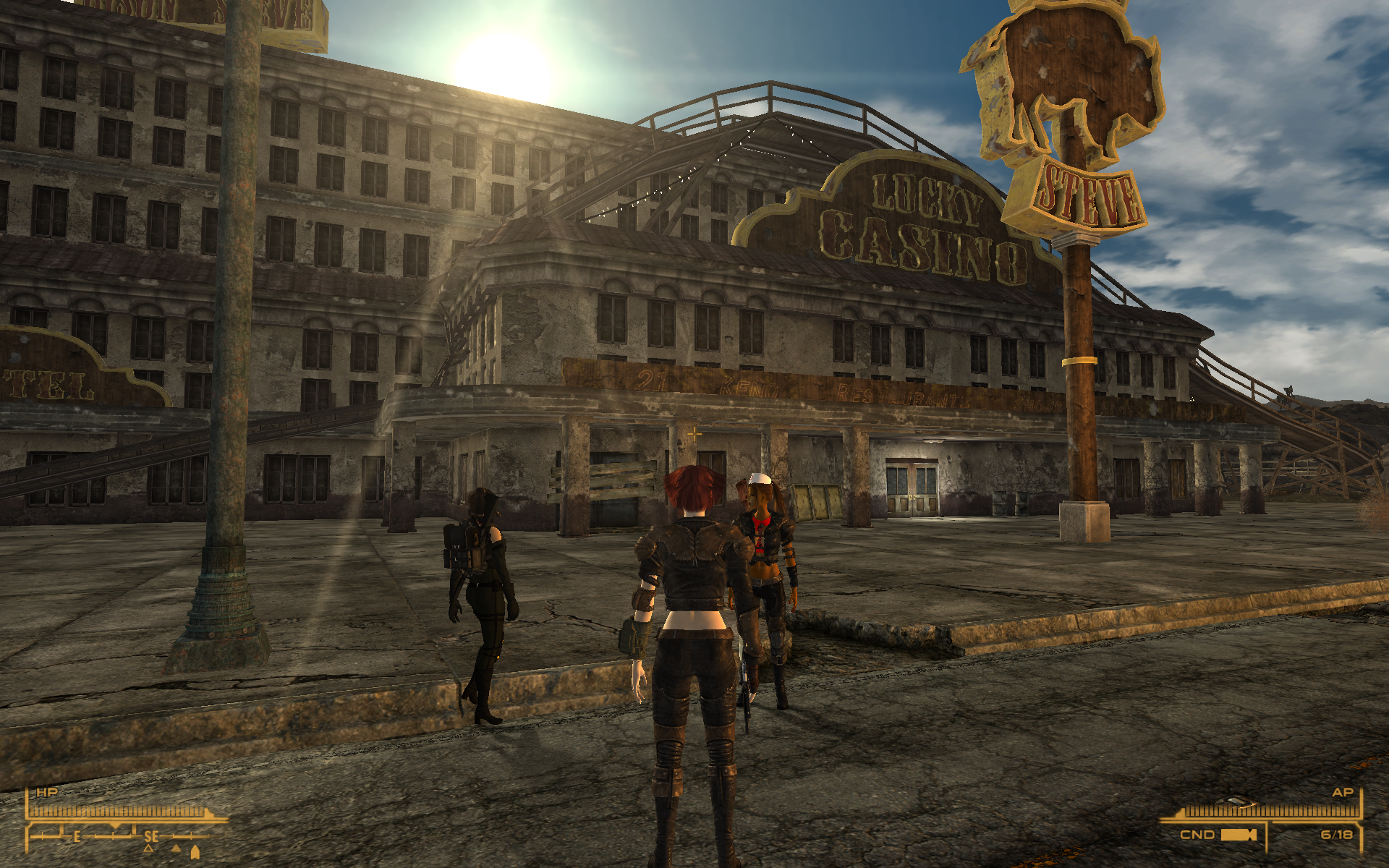
Fallout New Vegas replay with mods

So my dissertation’s main argument is that gamers become good gamers as they learn how to assemble in-game and out-of-game resources (both human and nonhuman) into their network of play so they can do what they need to do to succeed in the game and draw deeper meanings from their gaming. I thought I’d write about an example.

Fallout New Vegas with mods, screenshot of Bison Steve's in Primm, the main character and two companions

Continue reading Fallout New Vegas replay with mods

Announcing AGILE

[Edit April 21, 2011:] We’ve changed the name to Advancing Gaming in Innovative Learning Ecologies 🙂 [/Edit]

Advancing Games as Innovative Learning Environments (AGILE) is a group that includes LIFE Center and UWISME scholars in the College of Education at the University of Washington, most notably Theresa Horstman and myself. 🙂

What does this mean? Well, not much right now actually. We needed to brand ourselves, which will help with attracting attention and monies.