
[Edit March 28, 2013:
New website for Leet Noobs with excerpt and testimonials!
]
[Edit Oct 6, 2012:
I wrote a book!
Leet Noobs: The Life and Death of an Expert Player Group in WoW! (Amazon link)
It’s basically a major reediting with additional material thrown into the mix of my dissertation.
One of the surprising revelations I had while rewriting the book was that maybe the group fell apart in part due to their newfound conceptual understanding of how threat worked. What I mean is that, as they learned how the underlying math worked in the game, and as they focused more and more on efficiently exploiting this new knowledge, they inadvertently were also undermining their original motivations for playing. If this is true, what’s that mean?? Conceptual understanding can kill community? Was the way they were originally playing illegitimate? Anyway… interesting to think about since most people in education take for granted that conceptual change/understanding is all we care about.
]
[Edit Sep 7, 2010:
I defended my dissertation on August 20, 2010 (exactly 10 years after my brother and I finished our bike ride across America) and submitted it on September 2, 2010 (my birthday, so that some actual significance would be attached to the date for me). Get it at:
Leet Noobs: Expertise and Collaboration in a World of Warcraft Player Group as Distributed Sociomaterial Practice (PDF, 4 MB);
Or watch the YouTube videos of my dissertation defense;
Or download the PowerPoint used in my dissertation defense!
]
[Edit Feb 13, 2009:
I’ve moved slightly away from thinking about WoW as a two phase (two stage) process. I mean, it is helpful and maybe ethnographically correct–as in some players see it that way–but the line between the stages is very blurred, especially for anyone leveling up a character after their first one.
I wrote a paper that started out as me describing these two stages more. I intended to include things such as chat data and video analysis to illustrate the stages better, but I didn’t have time to do that kind of analysis for the deadline, so instead I turned it into a “how did ethnography help me” kind of paper, which seemed to make sense since it was for a special issue of Transformative Works and Cultures on ethnography and games.
Well, the reviewers, editor, and I eventually agreed that I should reframe what I submitted into a description of the social dimensions of expertise found in both stage one and stage two of character development. It’s a much better paper now after the review process than it started out as, but I’m afraid it reads a little hacked together (because it was a little hacked together!). Yet, I’m happy to say that it will, in fact, be appearing in TWC this Spring! 🙂
As for “Leet Noobs,” I am considering using it as the title for my dissertation, which, at this point, looks like it will be recasting the various publications I have through the lens of Actor-Network Theory/Distributed Cognition (maybe some Activity Theory thrown in, to boot) and be done by December 2009.
]
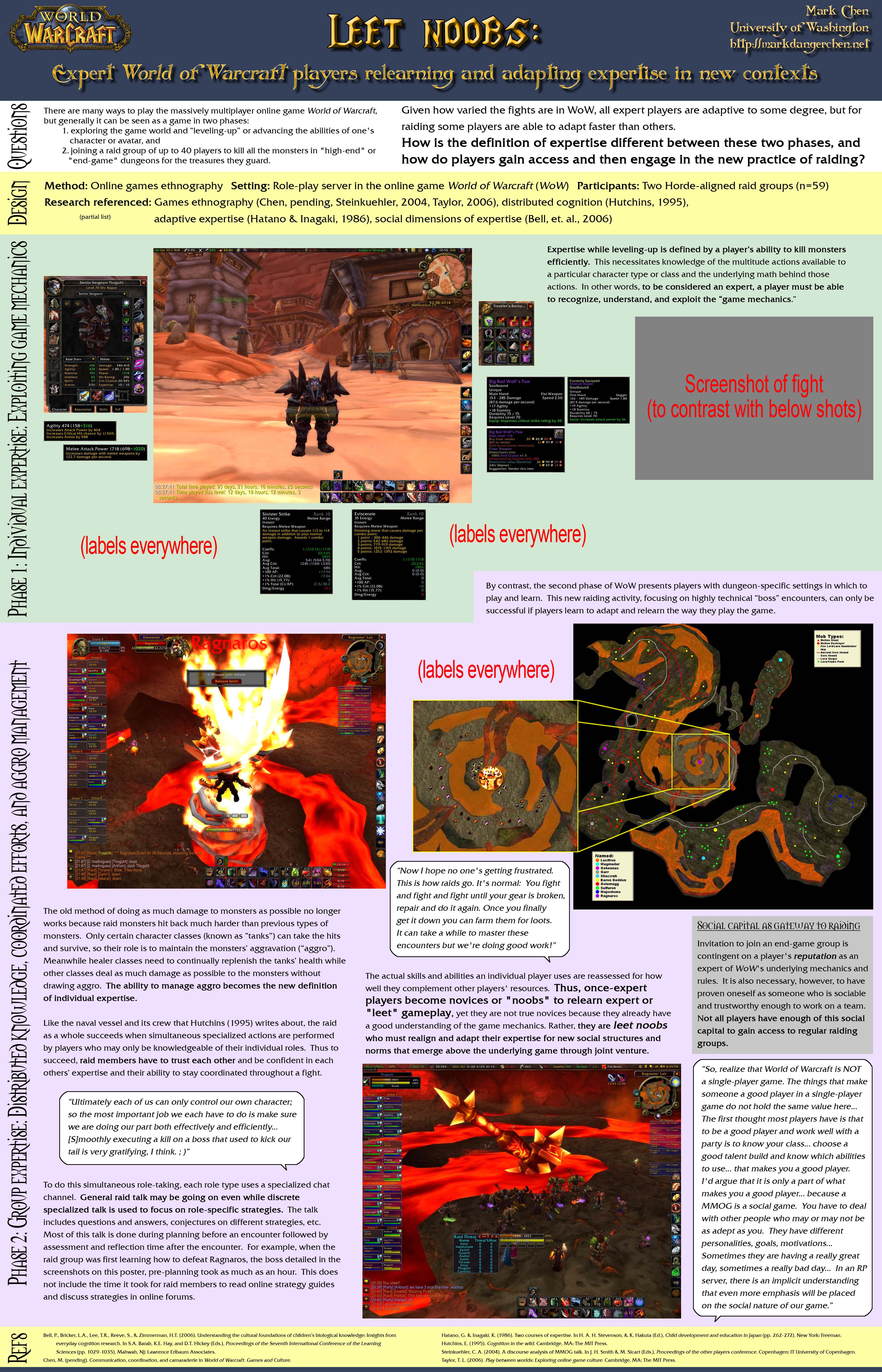
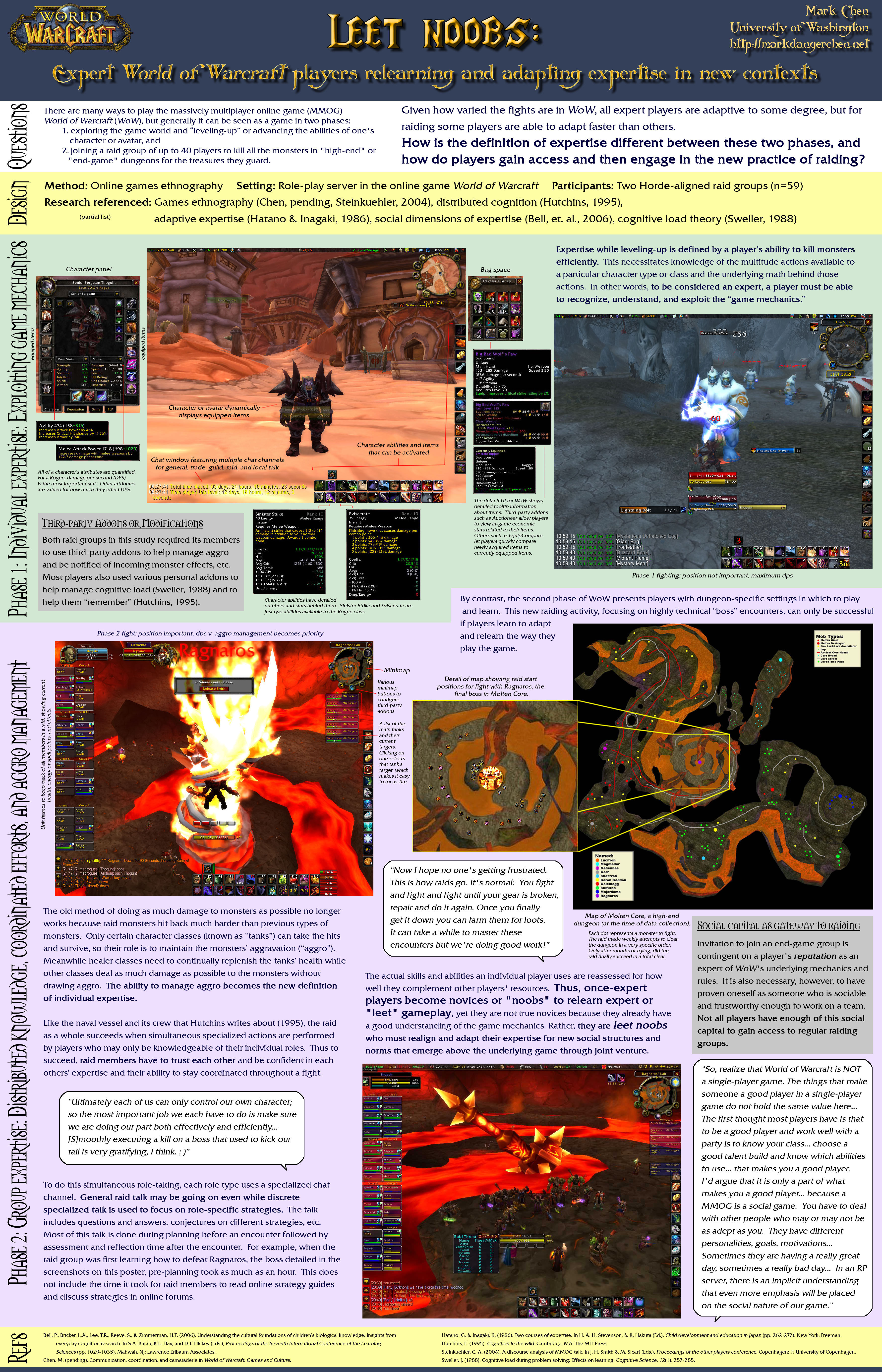
As part of a poster session on the development of expertise in everyday contexts at the International Conference for the Learning Sciences (ICLS), I created a poster that contrasts two phases of expertise development in World of Warcraft.

I also presented the same topic at Games Learning Society (GLS) a week later, but instead of using a poster, I printed out hand-outs and a map of a fight in Molten Core along with little paper figures to demonstrate with interactives what a raid fight looked like.

This page is meant to document the various iterations of this topic, and it will eventually include drafts of a paper I’m writing on it (due September 1).
First some background:
The first phase of WoW is while a player is leveling a character for the first time. Expertise is defined by learning the game mechanics, the abilities of the character class being played, etc. Basically, efficiency in killing things while playing alone or with a small group. In this phase, things like aggro management, positioning, etc. are not that important. A player who does this phase well is an expert player, aka, a leet player. (And, of course, things are a bit more individual/situated-context dependent than that, but, in general, I think this makes sense.)
The second phase occurs when an expert player joins a raid group and has to adapt his or her practice to work on a team. This phase is much more social, and, in fact, from the get-go successful access to a regular raid group depends on a player’s social capital and networks. Once in a group, max DPS (damage per second) is no longer the most efficient way of killing monsters. Instead, each character class has a specific role to play, whether it’s tanking, healing, decursing, doing damage, or what have you. The coordinated and collective effort of the group members is important.
The group works on a distributed level and the whole group is often considered one entity, but at the same time individual players have to keep track of their own actions. The process of learning and keeping track of personal stuff while maintaining relationships and successfully communicating and coordinating with the group is the new definition of expertise. The new raid activity requires new expertise. Thus leet players become leet noobs, experts who seem like newbies since they are in a new social context.
Here’s the abstract I submitted to both ICLS and GLS (the poster itself has a bigger reference section):
Leet noobs: Expert World of Warcraft players relearning and adapting expertise in new contexts
World of Warcraft (WoW), like many other massively multiplayer online games (MMOGs), can actually be seen as two different games. The first is the journey of exploring the game world and advancing the abilities of one’s character or avatar either through solo play or in groups of up to five players. This acts as a proving grounds or gateway for the second stage of WoW—joining a raid group of up to 40 players to kill all the monsters in “high-end” or “endgame” dungeons for the treasures they guard. Within a larger online games ethnography (Chen, in review) similar to others that describe player practice and learning (Steinkuehler, 2007, and Taylor, 2006), I have found that invitation to join an end-game group is contingent on a player’s reputation as an expert of WoW‘s underlying mechanics and rules. It is also necessary, however, to have proven oneself as someone who works well with others and understands his or her particular role in a team. Upon joining a raid group, players soon find that the conditions that determine expertise have changed because the activities and player practices have changed to fit the local context, which includes raid-specific tactics and new communication norms. It becomes clear that expertise is specialized for individual roles, depending on character type, and that to succeed as a raid group, players need to draw on their distributed expertise and knowledge (Hutchins, 1995), each doing their part while trusting others to do the same, so that collectively they act as a coordinated whole. Yet the actual skills and abilities an individual player uses are reassessed for how well they complement other players’ resources. Thus, once-expert players become novices or “noobs” to relearn expert or “leet” gameplay, yet they are not true novices because they already have a good understanding of the game system. Rather, they are leet noobs who must realign and adapt their expertise for new social structures and norms that emerge above the underlying game through joint venture. This poster highlights examples of learning individual expertise as well as new distributed expertise needed for raid group success.
Chen, M. (pending). Communication, coordination, and camaraderie in World of Warcraft. Games and Culture.
Hutchins, E. (1995). Cognition in the wild. Cambridge, MA: The MIT Press.
Steinkuehler, C. (2007). Massively multiplayer online gaming as a constellation of literacy practices. eLearning, 4(3), 297-318.
Taylor, T. L. (2006). Play between worlds: Exploring online game culture. The MIT Press.
Here are the various iterations of the poster:
In Everquest, I moved to a special server at one point. The relevant part of this, is that it was (at the time) the only option for people coming from the PvP servers to move to a regular raid setting.
This had two relevant parts:
1) you had an entirely new social setting, both because the new server involved a new group of people, and because the behavior of majority pvp players vs. majority non-pvp players is different.
2) Even non-raid character details change when you move from pvp to non-pvp. Important stats, what you pay attention to, etc. all have to change. There was some conflict with people thinking *I am the best at my class because I mastered pvp intricacies* vs. *I am the best at my class because I am the most successful raider*.
I won’t be able to thank you enough for the posts on your web page. I know you placed a lot of time and effort into these and hope you know how much I appreciate it. I hope I could do the same for someone else someday.
Thanks Jenifer!